CLP Labels for Candles in the UK
Professionally printed CLP labels structured specifically for candle packaging. Curved jars, tins and base labels require careful layout to maintain correct pictogram sizing and clear hazard presentation.
Each label is built using your fragrance supplier’s classification data and formatted for real-world candle vessels, from tealights to large jars.
Where required, recognised standards such as BS EN 15494 are incorporated alongside CLP information.
Choose Your Wax Melt CLP Format
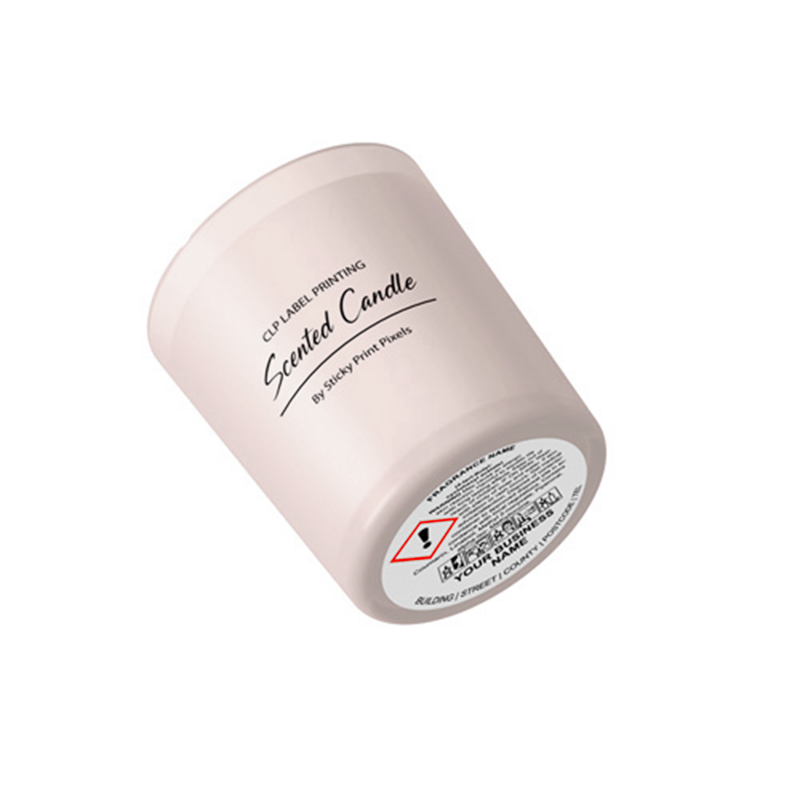

Candle CLP Label
Structured for jar candles, tins and boxed formats. Layouts are adapted for curved containers and circular base labels, ensuring hazard pictograms and statements remain clear and proportionate.
Built using your fragrance supplier’s GB CLP classification data and prepared for clean, professional presentation.
Why Properly Structured CLP Labels Matter for Candles in the UK
Candles containing classified fragrance ingredients require CLP labelling when supplied to consumers in Great Britain. The information displayed must reflect the classification data provided by the fragrance manufacturer and remain clear and legible on the finished container.
Unlike flat packaging, candle containers are typically cylindrical or curved. Jar diameter, base size and available print area directly affect how hazard pictograms, signal words and statements can be positioned without distortion or crowding.
On smaller jars, space constraints can impact pictogram scaling and text hierarchy. Careful layout planning ensures required elements remain proportionate, readable and professionally structured across glass jars, tins and boxed formats.
Each label is built using supplier-provided classification data and structured specifically for candle packaging geometry rather than adapted from flat wax melt layouts.
Candle Safety Icons. What You Really Need
Candle safety pictograms are not the same as CLP hazard symbols, and they are not generic. The correct icons can change depending on the type of candle (for example, container candles, pillars, tealights, or floating candles), so copying a random “standard set” can leave you with the wrong warnings for your product.
In the UK, candle safety pictograms are tied to recognised standards (such as BS EN 15494) and are intended to communicate safe use clearly and consistently. These icons are often placed alongside the CLP information for convenience, but they are a separate requirement and need to match the candle type.
For a full breakdown of how candle safety pictograms vary by product type, read:
Why Candle Safety Pictograms Are Not Generic
Common Candle CLP Labelling Issues
- Shrinking hazard pictograms to fit small jar bases
- Overcrowding text on narrow cylindrical containers
- Placing labels where curvature reduces readability
- Using layouts designed for flat packaging on curved jars
- Poor contrast on dark glass or metal tins
CLP Labels for Other Home Fragrance Products
Structured CLP labels for clamshells, snap bars and boxed melts, built using supplier classification data.
Reed Diffusers
CLP labels for reed diffusers and oil-based systems, structured for bottle formats and wrap layouts.
Room Sprays
CLP labels for alcohol-based and water-based sprays, with layout considerations for cylindrical bottles and trigger packaging.
Candle CLP Labelling – Frequently Asked Questions
Do all candles require CLP labels in the UK?
Only candles containing classified fragrance ingredients require CLP labelling when supplied to consumers in Great Britain. The requirement is based on the classification data provided by the fragrance manufacturer.
Unfragranced candles or products without classified substances do not require CLP hazard labelling. Where fragrance is present, the label must clearly display required hazard information in line with GB CLP presentation rules.
Can CLP labels be placed on the base of a candle jar?
Base placement is common for jar candles, provided the label is firmly affixed and remains clearly visible and legible to the consumer. Required hazard pictograms and statements must not be obscured or reduced below minimum size guidance.
In practice, the label must be positioned so that hazard information can be read without removing or damaging the packaging.
What size should a candle CLP label be?
Under GB CLP, minimum label dimensions are set out in Annex I and vary according to packaging volume. For smaller containers, the standard minimum label dimension is 52 × 74 mm where applicable. Hazard pictograms must measure at least 10mm × 10mm (measured on the red diamond frame) where packaging size permits.
In practice, selecting the largest suitable label size for your jar or tin allows clearer structure and improved readability.
Can hazard pictograms be reduced to fit small jars?
Hazard pictograms must meet minimum size requirements and remain clearly visible. Excessive reduction can affect clarity and presentation. Layout planning should prioritise proportion and readability rather than simply shrinking elements to fit limited space.
Do candle and wax melt CLP labels differ?
Where the fragrance oil percentage is the same, the CLP hazard information for candles and wax melts is typically identical. This is because CLP classification is driven by the hazardous properties of the fragrance ingredients. Wax itself is generally non-hazardous, so the risk assessment is based on the fragrance content.
However, candles are also subject to separate product safety standards, including BS EN 15494, which requires specific candle safety symbols such as “trim wick”, “keep away from children” and “burn within sight”.
These safety icons are not part of CLP but are often positioned alongside the CLP label for convenience. Our candle CLP layouts incorporate the required BS safety symbols where applicable, ensuring both hazard information and candle safety warnings are presented clearly.