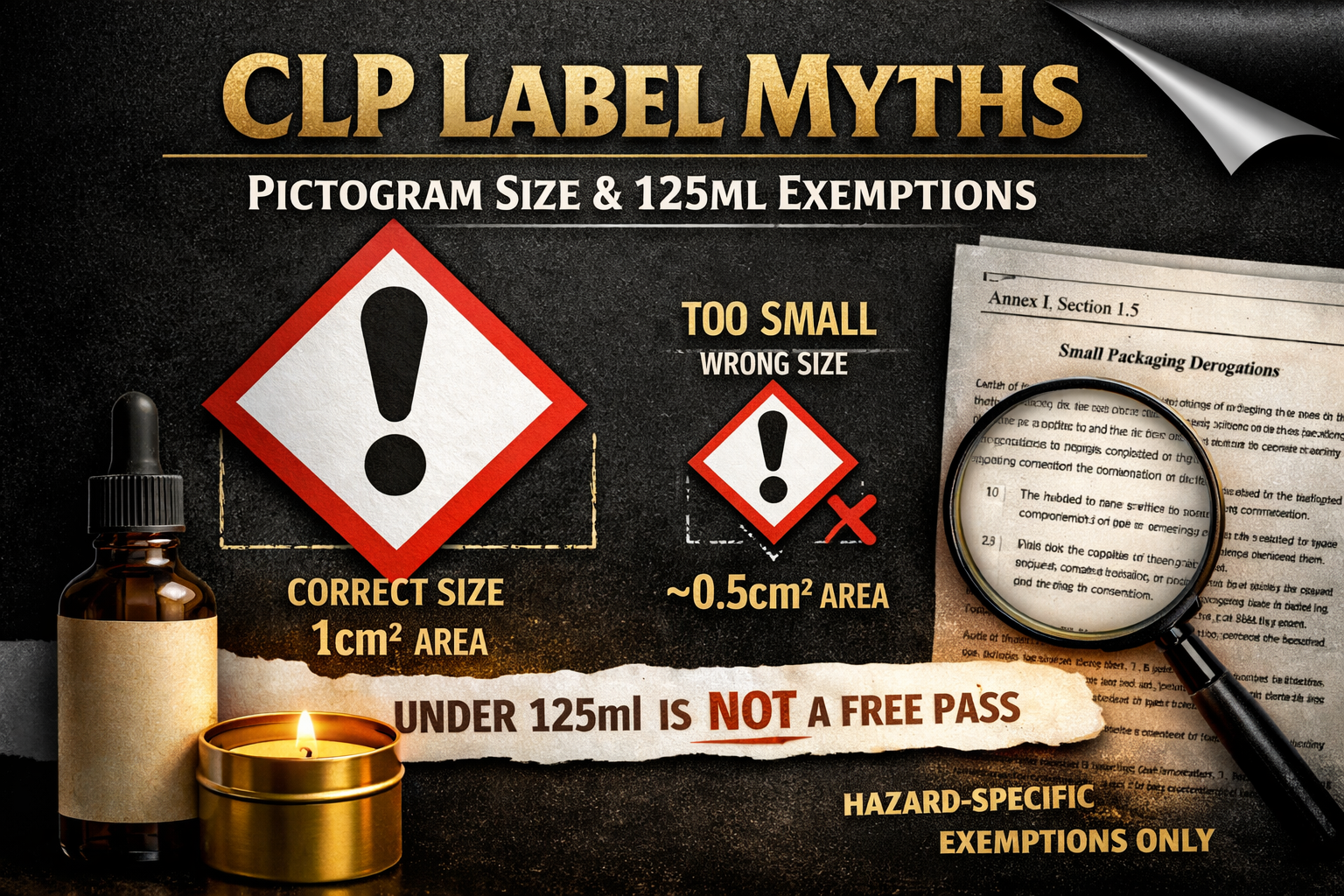
CLP Label Myths: Pictogram Size and the 125ml Exemptions
There are two bits of CLP advice that just will not die:
- “The pictogram only has to be 1cm.”
- “If it’s under 125ml you can strip most of the label off.”
Both are repeated with confidence. Both are usually wrong. And both are a result of people half-reading the regulation and then simplifying it into something it never actually said.
Myth 1: “The CLP pictogram only has to be 1cm”
The CLP Regulation does not say a pictogram must be “1cm tall”.
What it actually says is:
“The minimum area of each hazard pictogram shall not be less than 1 cm².”
(Annex I, Section 1.2.1 – CLP Regulation (EC) No 1272/2008)
A CLP pictogram is the red diamond and everything inside it.
That includes:
• the red border
• the white background
• and the black hazard symbol
It does not include:
• the invisible square around it
• the white outer corners
• or the space the diamond sits inside on your label
Legally, the pictogram is measured as a square before it is rotated, based on the length of the red edges.
So a compliant pictogram is:
• 10mm along each red edge
• which gives an area of 1cm²
Once that same square is rotated into a diamond shape, it becomes:
• about 14.2mm tall (top point to bottom point)
• and about 14.2mm wide (left point to right point)
This is where people go wrong.
They measure:
❌ from top point to bottom point
and make that:
❌ 10mm
That means the red edges are only about 7mm long, which gives a pictogram with roughly half the required area.
It may look fine to the eye.
It is not fine legally.
Measured legally:
✔ 10mm per side
What it occupies on your label:
✔ about 14mm tall and wide
Same symbol. Two very different levels of compliance.
Myth 2: “Under 125ml you can remove all the precautionary statements”
This one is worse, because it actively encourages people to remove safety information.
Small packaging exemptions do exist, but they are:
- Hazard-specific
- Conditional
- And limited
They are set out in Annex I, Section 1.5 of the CLP Regulation, which is titled:
“Derogations from labelling requirements for small packaging.”
The key wording is:
“Where the package is too small to accommodate the label elements required by Article 17, the label elements listed in Table 1.5.1 may be omitted.”
(Annex I, Section 1.5.2 – CLP Regulation)
That sentence matters more than most Facebook advice.
Because it does not say:
- Remove everything
- Ignore CLP
- Do whatever fits
It says:
- May be omitted (not “must”)
- Only the elements listed in the table
- Only for the hazards covered by the table
- Only when size genuinely prevents inclusion
This is not a free pass because you decided to use a small label on a larger product. It is hazard-dependent.
The Table of exemptions Is Hazard-Specific
The table being referred to is Table 1.5.1 of Annex I.
It lists certain hazard categories that "may" qualify for limited omissions, such as:
- Acute toxicity (certain categories only)
- Skin irritation (Category 2)
- Eye irritation (Category 2)
- Specific target organ toxicity (Category 3)
It does not say “all hazards”.
And it does not say “all label elements”.
Many of the hazards commonly found in home fragrance are not meaningfully covered by these exemptions, including:
- Skin sensitisation (H317)
- Aquatic chronic toxicity (H411, H412)
- Serious eye damage (H318)
Which means that for most candle, wax melt, diffuser and fragrance oil CLP labels, the usual elements are still legally required.
Precautionary Statements Are Not Automatically Optional
The regulation also states:
“The precautionary statements may be omitted except for those relating to disposal and those which are necessary to ensure the safe use of the substance or mixture.”
(Annex I, Section 1.5.2 – CLP Regulation)
So:
- You cannot remove disposal statements
- You cannot remove statements needed for safe use
- You cannot remove statements just because the bottle is small
Which statements are “necessary” depends entirely on the hazard. That is why the exemptions are hazard-specific in the first place.
Pictograms Are Not Automatically Optional Either
Another common mistake is removing pictograms simply because packaging is small.
CLP only allows derogation when inclusion is genuinely impossible, not when it is awkward or inconvenient.
From Article 29 of CLP:
“Competent authorities may allow derogations from certain labelling requirements where the nature or size of the packaging makes it impossible to apply them.”
(Article 29 – CLP Regulation)
If a compliant label fits, it is expected to be used.
“It’s fiddly” is not the same as “it’s impossible”.
Why This Matters for Home Fragrance
Most CLP classifications in home fragrance involve:
- Skin sensitisation
- Environmental toxicity
- Eye irritation
These hazards are not broadly exempt under small packaging rules.
Which means that removing:
- Pictograms
- Hazard statements
- Precautionary statements
purely because a product is under 125ml is usually incorrect.
If you are changing your label because someone in a Facebook group told you to, that is not a legal argument. It is not a defence. And it will not help if Trading Standards inspect your product.
The Short Version
- Small packaging exemptions are hazard-specific
- They do not apply to all CLP labels
- They do not apply to all hazards
- They do not allow you to remove everything
- And they do not override safe use requirements
If a compliant CLP label fits on your product, you are expected to use it.
Regulation reference: Regulation (EC) No 1272/2008 (CLP), Annex I Sections 1.2 and 1.5, and Article 29.
Share:
Is Net Weight Required on a CLP Label? Nominal Quantity Explained (UK Wax Melts)
IFRA 52 Could Be HUGE for Reed Diffuser Makers. Here’s Why