
Updated: August 2026
If you make reed diffusers, this is one IFRA update you’re going to want to keep a very close eye on.
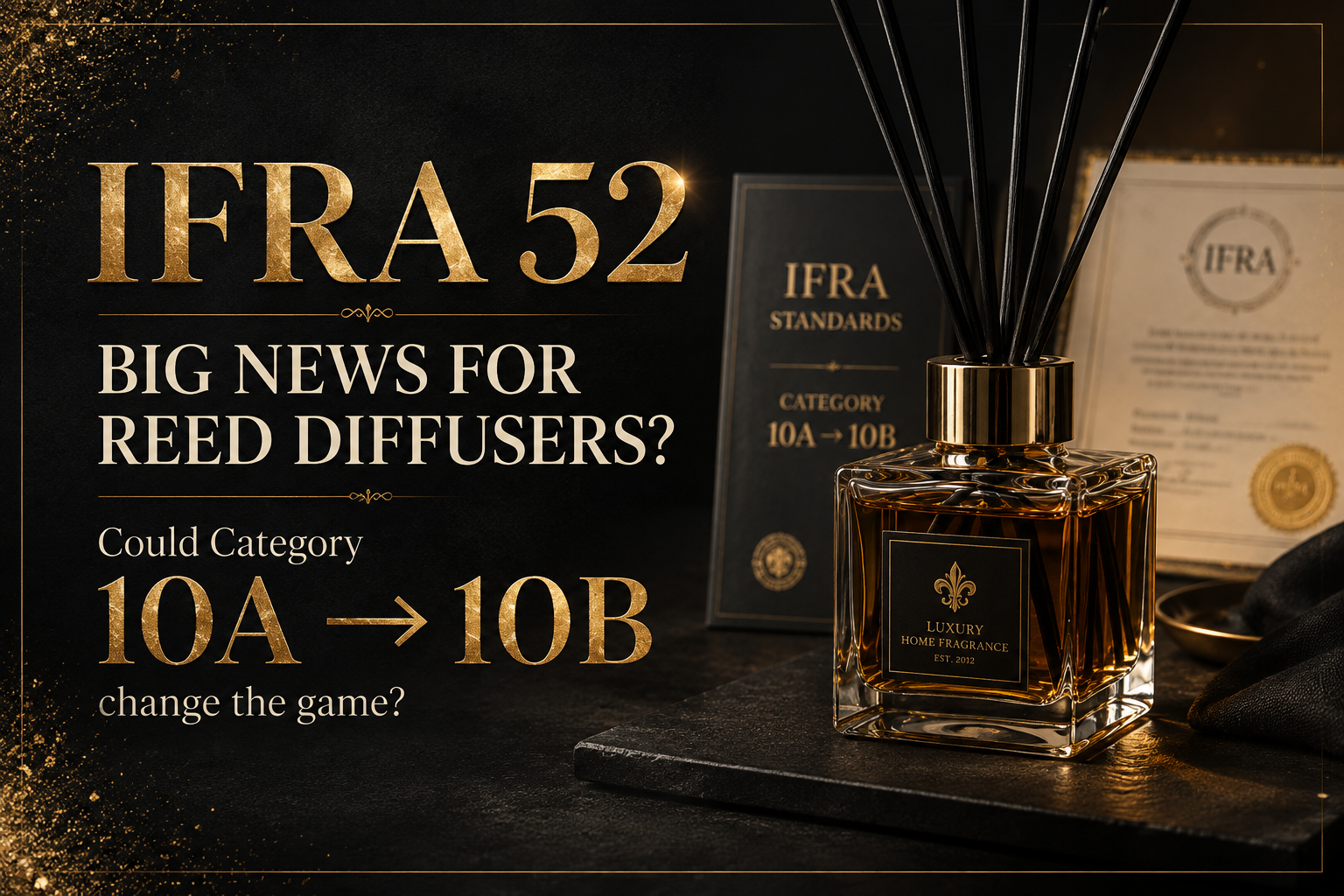
The upcoming 52nd Amendment to the IFRA Standards could potentially bring one of the most positive changes we’ve seen for reed diffuser makers in quite some time.
Why?
Because the way reed diffusers are categorised by IFRA has been under review, and if that review ultimately results in reed diffusers moving away from their current Category 10A treatment, it could mean significantly higher permitted fragrance concentrations for some fragrance oils.
For makers who have ever found the perfect fragrance oil, only to discover that its IFRA limit is too low for their usual diffuser formulation, this could be BIG news.
Before we all start celebrating, though, there is one very important caveat:
The 52nd Amendment has not yet been formally notified, and a move from Category 10A to 10B should not be treated as confirmed until IFRA publishes the final documentation.
So, no changing your formulations just yet!
For now, you should continue using your fragrance supplier’s current IFRA certificates and permitted usage levels.
What is an IFRA category?
If you regularly make candles, wax melts, room sprays or reed diffusers, you’ve probably downloaded an IFRA certificate from your fragrance oil supplier before.
Those certificates contain different product categories, with maximum permitted fragrance concentrations for each one.
The reason is simple: not every fragranced product exposes the consumer to fragrance in the same way.
A perfume applied directly to the skin is very different from a candle burning across the room, and a reed diffuser has different exposure considerations again.
IFRA categories group products according to these different exposure scenarios, and the category applicable to your product can make a huge difference to the maximum amount of a particular fragrance oil that can be used.
Where do reed diffusers currently sit?
Under the current IFRA guidance, reed diffusers sit within Category 10A.
And this is something that catches a surprising number of diffuser makers out.
You might normally make your reed diffusers using a 20% or 25% fragrance load.
You find a gorgeous new fragrance oil, order it, download the paperwork and then spot the problem:
Category 10A maximum: 12%.
Suddenly, that fragrance isn’t suitable for the formulation you normally use.
Your standard recipe doesn’t override the IFRA limit. If the current certificate says the maximum for the relevant category is 12%, then you cannot simply use it at 25% because that is the percentage you normally work with.
Why are reed diffusers Category 10A?
At first glance, it can seem a little strange.
After all, reed diffuser solution isn’t a product that is intentionally applied to the skin.
However, there are realistic situations where someone may come into contact with the liquid, including:
- Filling or refilling a diffuser
- Handling saturated reeds
- Turning or flipping reeds by hand
- Removing used reeds
- Accidentally spilling diffuser solution onto the skin
That potential hand exposure is one of the reasons reed diffusers have been treated under Category 10A.
And because IFRA restrictions are based on exposure and the ingredients contained within each fragrance formulation, being in 10A can result in surprisingly low maximum fragrance concentrations for certain oils.
So what is happening with IFRA 52?
IFRA periodically updates its Standards as new scientific information, exposure data and risk assessments become available.
The next major update is the 52nd Amendment to the IFRA Standards.
The public consultation opened in December 2025 and officially closed on 12 June 2026.
What makes this particularly interesting for the home fragrance industry is that the categorisation surrounding products such as reed diffusers has been under review.
And that brings us to the potentially exciting bit.
Could reed diffusers move from Category 10A to Category 10B?
This is the possibility that has diffuser makers talking.
If reed diffusers were ultimately moved from their current Category 10A treatment into Category 10B, the permitted concentration for some fragrance formulations could increase dramatically.
That could potentially open up fragrances that are currently unusable at typical diffuser fragrance loads.
However, I want to be very clear here:
A Category 10A to 10B move should not currently be treated as confirmed.
The final 52nd Amendment documentation has not yet been formally notified by IFRA.
Until it is, this remains something the industry should be watching closely rather than something makers should begin formulating against.
Why would Category 10B potentially be such a big deal?
This is where things get really interesting.
Imagine a fragrance oil that is currently restricted to around 12% in Category 10A.
You normally produce your reed diffusers at 20% or 25%.
Right now, that fragrance simply isn't suitable for your normal formulation.
But imagine that following a future categorisation change, the applicable maximum for that same fragrance increased to 25%, 30% or beyond.
Suddenly, a fragrance you couldn't realistically use in your diffuser range could become completely viable.
Multiply that across hundreds or thousands of fragrance oils and you can see why this has the potential to be such a positive development for the home fragrance industry.
For makers, it could potentially mean:
- More fragrance oils becoming suitable for reed diffusers
- Greater flexibility when formulating at 20–25%
- Fewer fragrances being ruled out because of very low Category 10A limits
- A wider choice of fragrances for diffuser collections
- More consistency when developing ranges across different fragrance oils
For a sector where IFRA limits can sometimes make the difference between being able to launch a fragrance or having to abandon it completely, that could be enormous.
But Category 10B would NOT mean every fragrance can be used at 30%
This is incredibly important.
If reed diffusers were moved to Category 10B, it would not suddenly mean every fragrance oil could be used at 25%, 30% or any other standard percentage.
There is no universal fragrance percentage attached to an IFRA category.
The maximum permitted concentration depends on the individual fragrance formulation and the restricted ingredients it contains.
One fragrance might have a very high maximum concentration, while another could still be restricted below your normal fragrance load.
You would therefore still need to check the current IFRA certificate for every individual fragrance oil you use.
This could explain why some suppliers don't offer a 25% CLP template
There is another really useful lesson here for diffuser makers.
Have you ever searched your fragrance supplier’s website for a 20% or 25% diffuser CLP template and wondered why it simply isn't there?
It isn't always because your supplier has forgotten to upload one.
The IFRA limit may be the reason.
If you want to make a diffuser containing 25% fragrance but that fragrance is currently limited to 12% for the applicable IFRA category, your supplier may not offer a 25% diffuser CLP template because the fragrance shouldn't be used at that concentration in the first place.
It is such an easy thing to overlook, particularly if you normally make all of your diffusers at the same fragrance percentage.
Always check the IFRA certificate before deciding your fragrance load — not afterwards.
IFRA and CLP are not the same thing
This is also a good opportunity to clear up a common source of confusion.
An IFRA Certificate of Conformity provides information relating to the permitted use of a fragrance mixture across different product categories under the IFRA Standards.
CLP, on the other hand, relates to the classification, labelling and packaging requirements applicable to chemical mixtures.
They are connected when producing home fragrance products, but they are not the same document and one does not replace the other.
A CLP template at a particular percentage does not give you permission to ignore the applicable IFRA restriction.
Likewise, knowing an IFRA maximum does not by itself provide everything required to produce the correct CLP label for your finished mixture.
Should you change your reed diffuser formulation now?
Absolutely not.
As exciting as the potential change is, nothing should change in your workshop yet.
Continue using the current IFRA documentation supplied by your fragrance oil manufacturer or supplier.
If your current IFRA certificate limits a fragrance to 12%, don't increase it to 20% or 25% because you've heard that reed diffuser categorisation may change.
We need to wait for the final 52nd Amendment and, crucially, for fragrance suppliers to assess their individual fragrance formulations and issue updated documentation where necessary.
What should reed diffuser makers do now?
For now, there is no need to panic, reformulate or start changing products.
But there is every reason to be excited and keep watching.
- Continue using your current IFRA certificates.
- Check the permitted concentration for every fragrance individually.
- Don't assume every fragrance can be used at your standard diffuser percentage.
- Continue using the correct CLP information for your finished product.
- Keep an eye out for updated documentation from your fragrance suppliers.
- Do not formulate using proposed future limits until they are officially applicable.
When will we know more about IFRA 52?
The consultation for the 52nd Amendment closed on 12 June 2026.
The industry is now waiting for the final Notification and documentation.
That is when we'll be able to see exactly what has changed and, most importantly for us, what the final categorisation means for reed diffuser products.
After that, fragrance suppliers will need to work through the changes and provide updated documentation for their individual fragrance oils where applicable.
This could be a HUGE positive change for the diffuser industry
I don't think the potential significance of this should be underestimated.
If the final IFRA 52 changes result in reed diffusers being placed into a category that allows higher maximum concentrations for some fragrances, it could open the door to fragrance oils that many diffuser makers currently cannot use at commercially practical concentrations.
That could mean more choice.
More flexibility.
Fewer disappointing moments when you discover your brand-new fragrance is capped well below your normal diffuser percentage.
And potentially a much broader fragrance palette for the entire reed diffuser industry.
That really would be fantastic news.
We're just not popping the champagne quite yet.
Until IFRA formally publishes the 52nd Amendment, keep following the current documentation for your fragrances.
But I'll be watching this one very closely and as soon as the final changes are confirmed, I'll be digging into exactly what they mean for reed diffuser makers.
Watch this space. This could get very interesting.
Share:
CLP Label Size Rules Explained: Pictogram Measurements and 125ml Exemptions